

From First Flight to Future Leaders: Mike Mower Shapes Aviation Excellence at SUU
Published: March 19, 2026 | Author: Gabrielle Costello | Read Time: 4 minutes
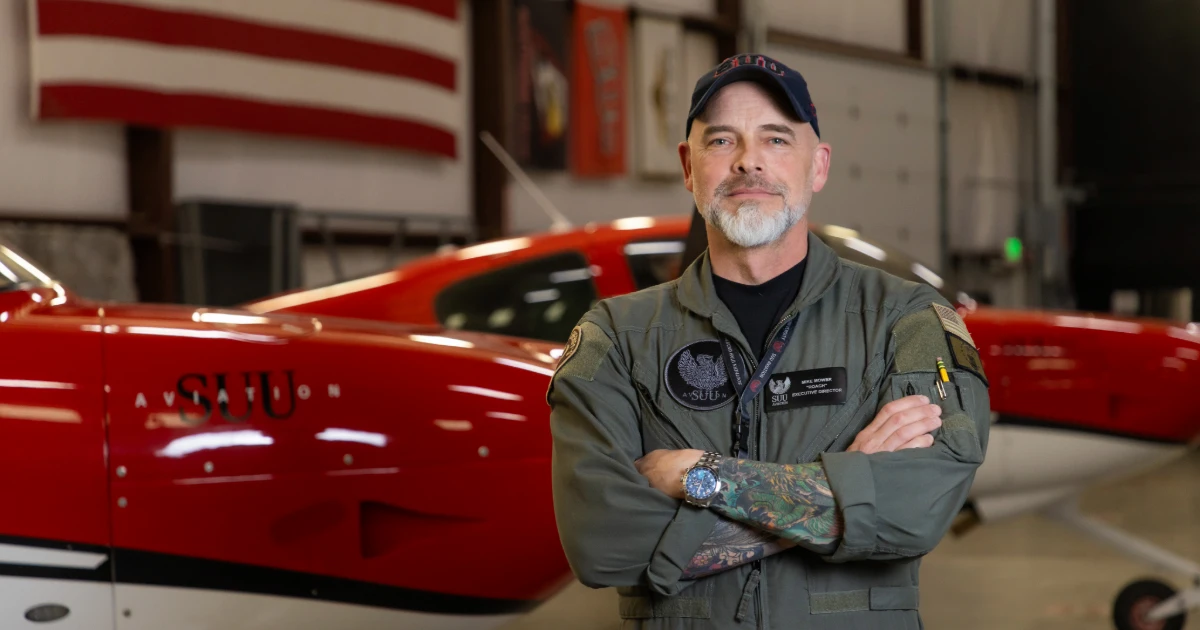 For Mike Mower, aviation isn’t just a career, it’s a lifelong passion that has taken flight in southern Utah and transformed into one of the nation’s leading collegiate aviation programs.
As executive director and chief instructor of the School of Aviation at Southern Utah University (SUU), Mower has spent more than a decade building the program from the ground up. Since arriving in 2012, he has helped grow it into a nationally recognized leader in aviation education, with graduates flying on every continent.
“I’ve been flying helicopters for about 20 years and it’s just become my life,” Mower said. “To come down and start something from scratch, and then watch it grow into what it is today, has been incredible.”
An SUU alumnus himself, Mower earned his bachelor’s degree in aviation along with master’s degrees in both aviation and public administration. His deep connection to the University fuels his commitment to student success and program innovation.
From its inception, SUU’s School of Aviation was designed with a clear goal: align education directly with workforce needs. Rather than following traditional aviation training models, Mower and his team built a curriculum shaped by ongoing input from industry partners.
“We constantly ask industry professionals, ‘What are you looking for?’ and then adjust our curriculum to match,” Mower said. “If we train students in a way that doesn’t meet industry expectations, that’s a failure on our part.”
That approach has led to distinctive training opportunities across all areas of aviation. Helicopter students receive advanced instruction in high-altitude operations, night vision, and turbine aircraft, while fixed-wing students gain experience in multi-engine aircraft, spin training, and tailwheel operations. On the maintenance side, the program has even influenced changes to federal training regulations, allowing for more customized, industry-specific instruction.
“Theory without application is useless,” Mower said. “We put students in real scenarios where they have to think, react, and apply what they’ve learned, which is an approach strongly supported by the Federal Aviation Administration (FAA).”
This practical focus is reinforced by small class sizes and individualized instruction. While ground courses typically include fewer than 30 students, flight training is even more personalized, with instructors working one-on-one or in very small groups.
The program’s reputation has drawn students from across the United States and around the world. Today, the School of Aviation represents all 50 states and multiple countries, creating a diverse and dynamic learning environment.
Mower also highlights the unique training opportunity southern Utah provides with being surrounded by national parks and high-altitude terrain. The program has grown to include one of the largest collegiate helicopter training operations in the country and the highest-altitude training program of its kind, preparing students for anything.
While many aviation programs focus solely on technical skills, SUU emphasizes leadership alongside flight and maintenance training. Graduates leave not only with certifications, but with the ability to lead teams and shape the future of the industry.
At the heart of the program is an unwavering commitment to safety. Mower emphasizes that every member of the aviation community, from students to administrators, has the authority to pause operations if something doesn’t feel right.
“Our mission is to take off, fly, and come back safely,” he said. “If training happens along the way, that’s great, but safety always comes first.”
For Mower, the most rewarding part of his role is witnessing students achieve their dreams. From their first flight to earning professional certifications and launching careers.
“To see someone come in with no experience and leave as a professional pilot or mechanic, it’s amazing,” he said. “Sometimes I even get to hand them their certificate; that moment never gets old.”
His advice to prospective students is simple but honest: aviation is challenging, but it’s achievable.
“It’s hard work. It’s not as glamorous as people think,” Mower said. “But if it’s your dream, don’t give up. Keep pushing forward,you can get there."
Career pathways for graduates span the full spectrum of aviation from commercial airlines and corporate aviation to emergency medical services, firefighting, law enforcement, and maintenance operations. According to recent studies by Boeing and Airbus, the demand for pilots and technicians has grown rapidly and is predicted to grow even more.
With the University’s supportive culture and dedicated faculty and staff, the School of Aviation continues to grow and is preparing students not just for careers, but for long, safe, and impactful futures in aviation. Learn more about SUU’s vast Aviation Program and opportunities here.