

SUU Valley Farm Participating in Statewide Water Optimization Project
Published: April 30, 2026 | Author: Gabrielle Costello | Read Time: 4 minutes
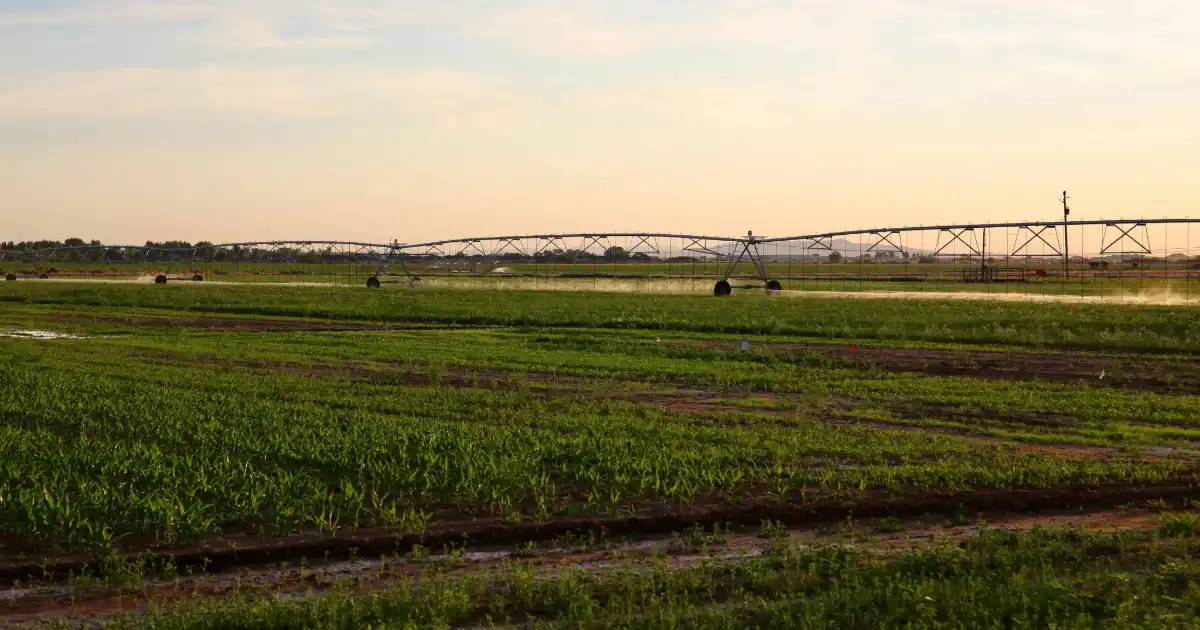 As water scarcity continues to challenge agricultural communities across the West, SUU Valley Farm and USU Researchers are working with regional farmers and statewide partners to develop innovative irrigation strategies that improve efficiency while sustaining crop production.
Agriculture accounts for the majority of water use in many western states, including Utah, and increasing drought conditions have placed added pressure on producers to conserve resources.
"In our Cedar Valley alone, groundwater is currently being overpumped by an estimated 8,000 acre-feet annually," said Morgan Christensen, Farm Manager at SUU Valley Farm. "That's nearly 2.5 billion gallons each summer of overpump."
Farmers face concerns in figuring out how they can keep their businesses viable while reducing their water footprint. The goal of local water researchers is to provide approaches and technologies that help address those concerns.
Over the past several years, the research team has focused on improving water management through a combination of irrigation technology, crop selection, and soil practices. By collaborating with partners like Utah State University and the Western Sustainable Agriculture Research and Education program (Western SARE), our region is exploring funding long-term studies that examine how different conservation strategies perform in real-world farming conditions.
Low-elevation Precision Application (LEPA)
The research team is studying multiple water nozzle packages as solutions to more efficiently apply irrigation water. One area of study being applied at SUU Valley Farm is Low-elevation Precision Application (LEPA), particularly the use of variable rate irrigation systems on large center-pivot sprinklers. While these systems are designed to distribute water evenly, fields themselves often vary in soil type, slope, and crop needs. As a result, some areas may be overwatered while others receive too little. This is an important technology applied at SUU's Farm due to the windy climate of Cedar City.
"At our University's farm, irrigating with the LEPA system has proven to be extremely efficient," said Christensen. "The lower we can get the water, even sometimes all the way inside the crop canopy, we can get zero evaporation happening."
Combined with localized weather stations, the research team is studying technology that allows farmers to apply the exact amount of water needed for specific zones of a field, preventing water waste and nutrient loss.
Researchers have found that the LEPA technology yields the best numbers, particularly in areas with level land. However, research has also found that LENA (Low-elevation Nelson Advantage Application) and LESA (Low-elevation Spray Application) are other options for farmers, with less efficiency when compared to LEPA, but acts as less expensive to put on the pivot overall. SUU Farm is utilizing all three of these technologies in the trial.
SUU Farm is also experimenting with Mid-elevation Sprinkler Application (MESA) in the trial, however, not much success has been found due to evaporation loss in the windy climate.
Field trials comparing full irrigation with reduced irrigation strategies have produced promising results. Researchers found that many crops can maintain similar yields with up to 25 percent less water, particularly when irrigation is timed to match critical growth stages.
Local producers have already begun implementing some of these practices. At one regional farm, nearly 10,000 acres have been converted to low-elevation irrigation systems, reducing water use by an estimated 15 to 20 percent in alfalfa production.
Looking Ahead
Farmers say participation in research projects is essential for long-term success. Even modest efficiency improvements, such as saving 10 percent in water or fertilizer, can significantly impact profitability in an increasingly competitive agricultural economy.
The project also provides valuable hands-on learning opportunities for students who are looking for real-world application to their studies. By working directly with farmers, undergraduate and graduate researchers gain insight into the practical challenges facing modern agriculture while contributing to solutions that support sustainable food production.
In addition to irrigation technology, the team is studying alternative crop varieties that may require less water. Long-term studies are also underway to better understand how soil management practices like reduced tillage and cover cropping influence water efficiency over time.
Researchers emphasize that sustained investment in irrigation research is critical as drought conditions become more common across the western United States.
"In many places, agriculture cannot thrive without reliable water supplies," said Principal Investigator, Dr. Matt Yost from Utah Valley University. "We have to understand the long-term trends and impacts if we want to effectively deal with drought and water scarcity."
The research team plans to continue expanding the project by seeking additional long-term funding to further explore solutions that balance agricultural productivity with responsible water use.
As a university with a strong agriculture background, SUU is proud to be contributing to research that supports the agriculture community, while still being able to successfully maintain its daily operations.
Contact Information
Brooke Heath
435-586-5400
brookeheath1@suu.edu