

Dancers Engage in World-Building at SUMA
Published: May 04, 2026 | Author: Kol Gibson | Read Time: 6 minutes
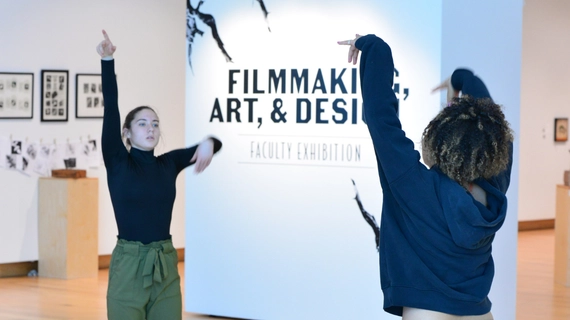 In the quiet, light-filled galleries of Southern Utah Museum of Art (SUMA), something unexpected took shape this semester: dance. At Southern Utah University, Assistant Professor of Dance Joshua Yago Mora invited their Dance Composition I students to step out of the studio and into the museum. There, surrounded by paintings, sculptures, and installations, students created 19 original dance works inspired by SUMA’s Filmmaking, Art, & Design Faculty Exhibition.
For Mora, the idea was rooted in experience. Some of their favorite memories as a dancer happened in museums. They wanted their students to feel that same kind of inspiration, where art is not just something you look at, but something you respond to.
“I hoped for my students to find inspiration from both the space itself as well as the works held in the space,” Mora said. Having faculty artwork on display made the experience even richer. Students had the chance to talk directly with the artists and learn about their creative process, and that connection shaped the entire project.
Dance Composition I, as Mora frames it, is less about perfecting steps and more about experimentation. It is a laboratory where students can test ideas, take risks, and figure out what kind of artists they want to be. Instead of starting from nothing, this project gave them a new approach. They began by studying someone else’s work, then used that understanding to build their own.
“My main goal was to give a different in-road to creation,” Mora explained. By looking closely at visual art, students could better understand their own artistic voice. “We don’t always have to reinvent the wheel, and when we lean on what has been done before, we as artists have the opportunity to know ourselves better, and in turn create work with a stronger voice.”
In the weeks leading up to their time at SUMA, students practiced this kind of observation through written analyses of dance. They learned to articulate what they valued, including how movement functioned, what emotions emerged, and what compositional choices stood out. Then, drawing on Laban/Barteneiff principles such as Body, Effort, Space, and Shape, they began translating visual elements like shape, contrast, and texture into movement. From there, the work became their own.
Students selected works from the faculty exhibition and developed original choreography in response. They were encouraged not only to observe, but to connect by reaching out to the visual artists, asking questions, and considering how another creator’s process might inform their own. The assignment blurred boundaries between disciplines and turned interpretation into collaboration.
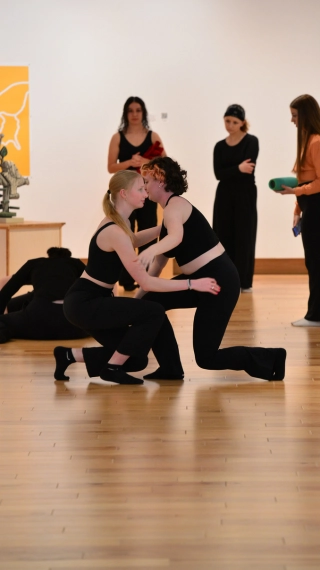 For Musical Theatre major Kira Paskett, that collaboration became deeply personal. Inspired by The Entropy of Status by Russell Wrankle, Paskett found herself not only responding to the work, but also entering into dialogue with its creator. “I have always enjoyed walking through SUMA, but using someone else’s art to inspire my own was one of the most empowering experiences I’ve had,” she said. “Meeting with Russell to talk about his process with his piece in the museum, as well as his ceramics, helped me understand how creating art can be so similar in each medium.”
What surprised her most was that her interpretation did not match the artist’s original intent, and that that was okay. “The inspiration I took from his piece was different than what his intended purpose was,” she reflected, “but I learned that is the point of art.” That realization, paired with the experience of direct artistic exchange, left a lasting impact. “Artistic collaboration is something I look forward to experiencing for the rest of my life, and this project helped me feel confident in my ability to do that.”
Working in a museum also changed how students approached choreography. In a studio, dancers control the space. In a gallery, they have to share it. They must be aware of walls, artwork, and other people. Mora noted that this creates a kind of “forced perspective,” where other works are always present and quietly shaping what you make.
It also led to moments that surprised even Mora. In one case, a student created a dance that closely reflected the life experiences of the artist they were studying, even though they had never met. The connection felt almost accidental, but also deeply meaningful.
Experiences like that reflect the larger goals of SUU’s Dance program. Students are not just learning steps. They are learning how to think, communicate, and create with purpose. They write, reflect, and discuss their work, building skills that go beyond performance and prepare them to excel in their other classes and their careers after graduation.
For Mora, this kind of learning is about more than technique. It is about relationships between people, ideas, and art forms, and is influenced by the 8 Ways of Aboriginal Learning. The 8 Ways focus on how knowledge is shared and how communities grow through connection, and have become central to Mora’s pedagogy. In that sense, the project was not just about making dances. It was about learning how to connect.
It also shows the value of having an academic museum like SUMA on campus. Museums are not only places that hold art from the past. They are spaces where new ideas can begin. They bring together different voices and open the door to new conversations.
Mora believes that kind of exchange is essential, especially in a world that is becoming dominated by artificial intelligence. “It is important for every student to engage with every art form and every discipline,” Mora explains. “Without engagement of the breadth of humanity, we will be diminished to cogs in a machine that will only, at best, mimic humanity. We can no longer create in isolation.”
Artists are “world builders,” according to Mora, because they make something appear from nothing. “As we build worlds, the more people we know and the more processes we understand, the more our worlds can hold and evolve,” they explained. “Museums are another voice of world builders. They show us what has been done, the histories we hold, and while preserving what has been made, they force conversation of what could come.”
In the galleries of SUMA, that world-building was on full display. Nineteen dances, each one shaped by a different piece of art, a different perspective, and a different story. Together, they showed what can happen when disciplines come together in one space. It is not just about dance, but about dialogue, and as Mora put it, art forms can and should always be in conversation.
To learn more about Dance at SUU, please visit www.suu.edu/pva/tdaa/dance.
Photo credit: Jason Moodie on behalf of Southern Utah Museum of Art
About the College of Performing and Visual Arts
The College of Performing and Visual Arts (CPVA) at Southern Utah University comprises 41 academic programs, including liberal arts (BA/BS) and professional (BFA, BM, BMEd) degrees in art, design, dance, filmmaking, music, and theatre. It includes graduate programs in the fields of arts administration (MFA, MA), music education (MME), and music technology (MM). More than 60 full-time faculty and staff are engaged in teaching and mentoring over 900 majors in the College. CPVA presents over 100 performances, lectures, presentations, and exhibitions each year, which are complemented by the Southern Utah Museum of Art (SUMA) and Shakespeare Studies at SUU, and is affiliated with the Tony award-winning Utah Shakespeare Festival (USF). Southern Utah University is an accredited member of the National Association of Schools of Art & Design (NASAD), National Association of Schools of Dance (NASD), National Association of Schools of Music (NASM), and the National Association of Schools of Theatre (NAST), making SUU the first public university in the state of Utah to be accredited by all four associations. For more information about the College of Performing and Visual Arts, visit www.suu.edu/pva.Contact Information
Kol Gibson
435-865-8667
kolgibson@suu.edu