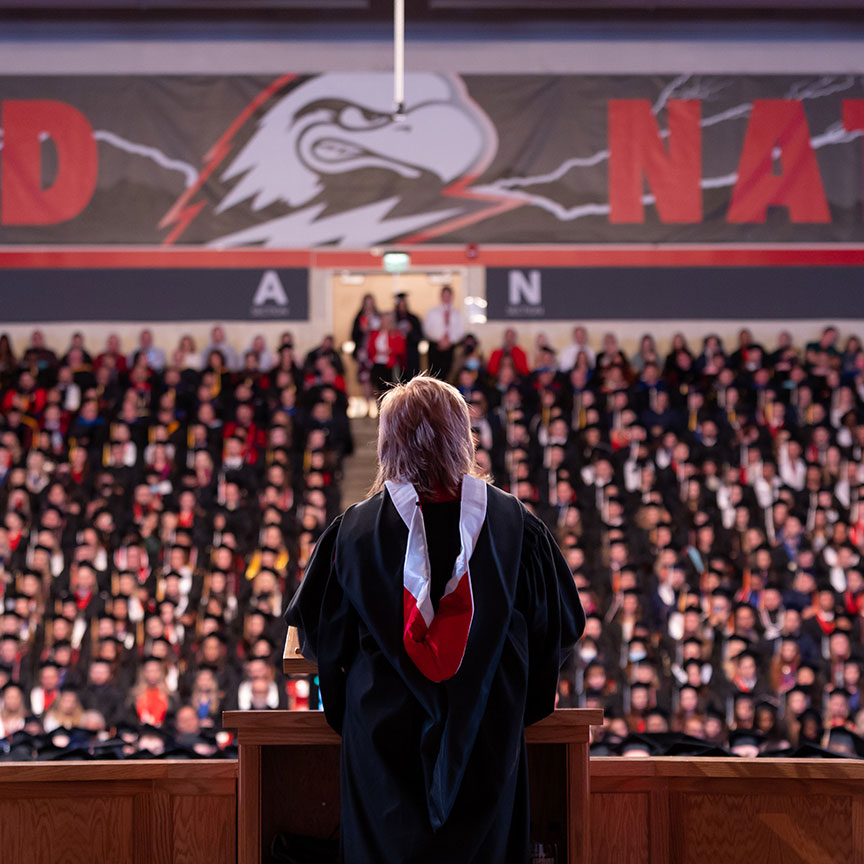
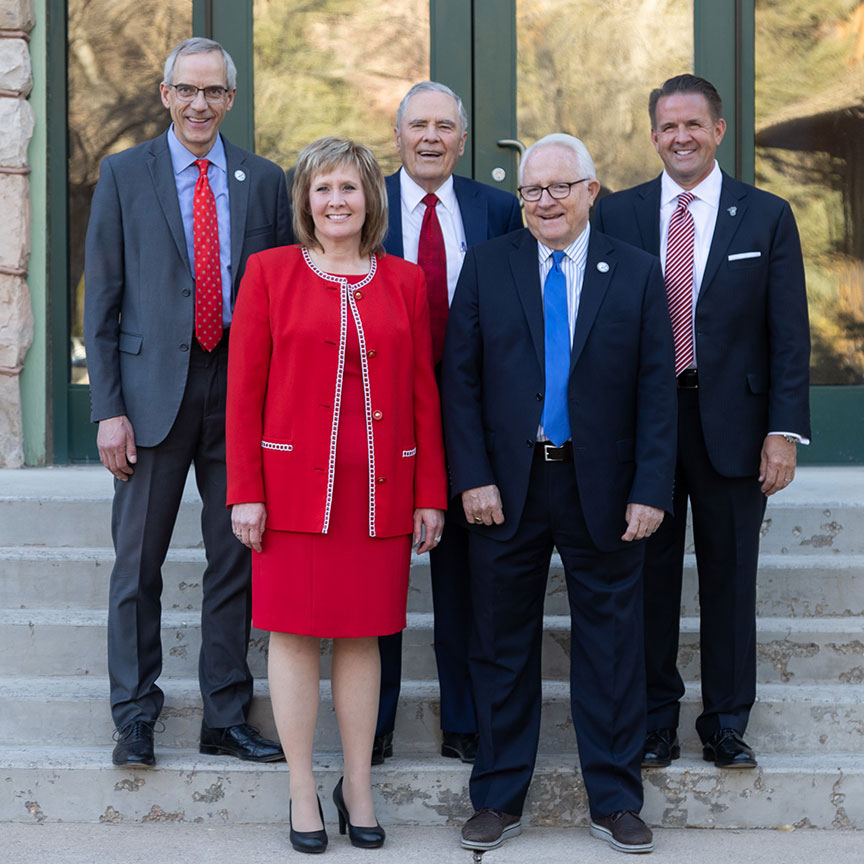
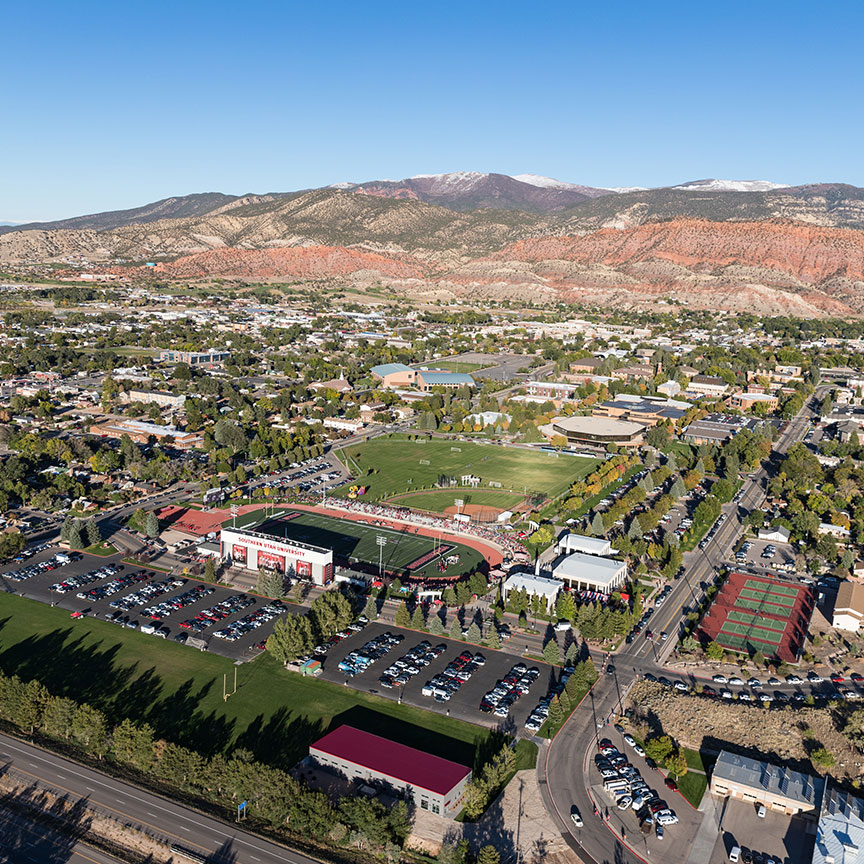
In 1897 the founders of Southern Utah University believed so strongly in the power of education that they risked their lives and finances for the privilege of building and hosting an institution of higher education in rural Cedar City, Utah. Their determination and grit are woven into the cultural fabric of the University. SUU’s enduring legacy is built on 125 years of fortitude, determination, and community triumph. It is that dedication to this school that is celebrated once again in the ceremonial inauguration of Mindy Benson, 17th President of SUU.
The fancy gowns worn today in commencement and inauguration ceremonies were once everyday dress in the 12th century. By the 17th century, as styles changed, and wealth and rank began to be more and more distinguished, gowns became the costume of only clerics, law professions and academics.
The academic gowns worn today are based on the clothes of medieval monks. English universities adopted the custom, and American universities, based on the English model, continue to use them today. According to Harris, “In a 1939 booklet, The Story of Caps and Gowns, Helen Walters cites a 1358 decree from Oxford that stated “it is honourable and in accordance with reason that clerks to whom God has given an advantage over the lay folk in their adornments within, should likewise differ from the lay folk outwardly in dress.” The unusual dress helped a largely illiterate public discern the wearer’s status as an educated man (2005, p. 5).
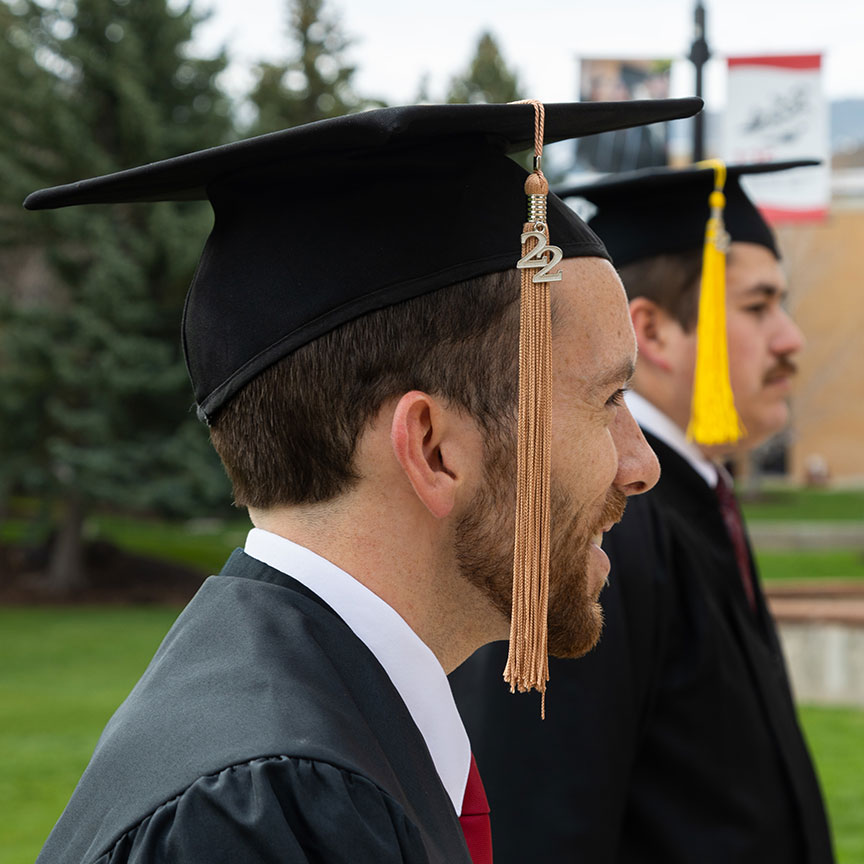
Mortarboards and Tams
The mortarboard is the flat head piece that accompanies the gown. It is uncertain where the tradition began, though several theories have been advanced.
E.B. Boatner, in a 1998 article in the Harvard University Gazzette, offers this explanation, “One anonymous legend cites a wise old Greek who decked his students out in mason’s sackcloth robes with mortarboards because ‘their destiny is to build. Some will build cities, some will build lives, perhaps one of them will build an empire. But all will be builders on the foundation of knowledge’” (Harris, 2005, p. 12).
In recent years, Ph.D.s have begun to wear tams. They are made of soft velvet with four, six or eight corners. The tam, unlike the mortarboard, does not have an inflexible top.
Inauguration Procession
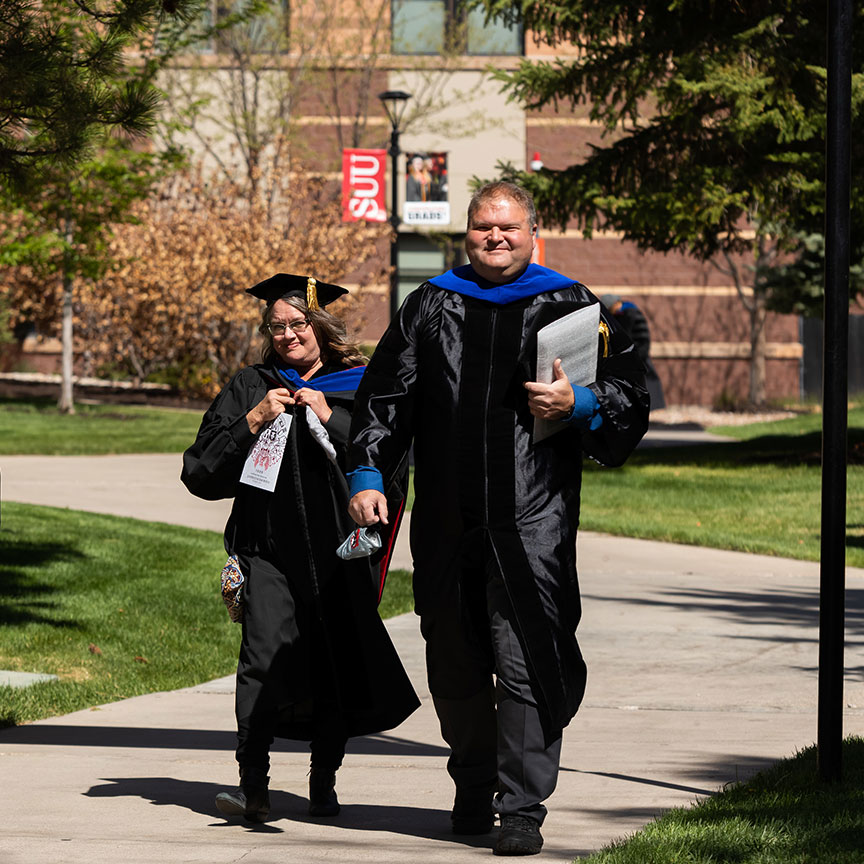
Like commencement, the inauguration procession is an opportunity to display both the contemporary and historic beauty of an institution. It differs from a commencement ceremony in that delegates from other universities and representatives from learned societies also participate.
Those walking in the procession wear full academic attire—gowns, mortarboards and tams, and tassels. Those representing cultural groups dress in the appropriate costume of their custom.
Installation Ceremony
In the installation ceremony, the reigns of the university are officially handed over to the new president. It is the crowning jewel of the inauguration and full of symbols. As she accepts her position, specific institutional memorabilia is given to the incoming president. Says Harris, “Finally, the climatic moment arrives when the head of the school’s governing body or governor of the state rises to commend the authority of the institution to the new president. The school’s charter and/or other founding documents are placed in the president’s hands, and the medallion or chain of office is placed around his or her shoulders (2005, p. 52).”
Delegates from Other Schools
A distinguishing feature of the inaugural ceremony is the presence of delegates from other “institutions, learned societies, elected officials, alumni, donors, students and community leaders” (Harris, 2005, p. 53). The presence of representatives from other colleges and universities dates back to the beginning of American academia. In the old days, presidents of almost every four-year American university and college were invited to attend inaugural festivities and march in the procession. In addition, leaders of foreign universities were invited. Today, the large number of bachelor’s degree-granting institutions…make this custom impractical (Harris, 2005, p. 53). However, it is still a time-honored tradition to invite leaders of various schools at the request of the incoming president.
The Mace
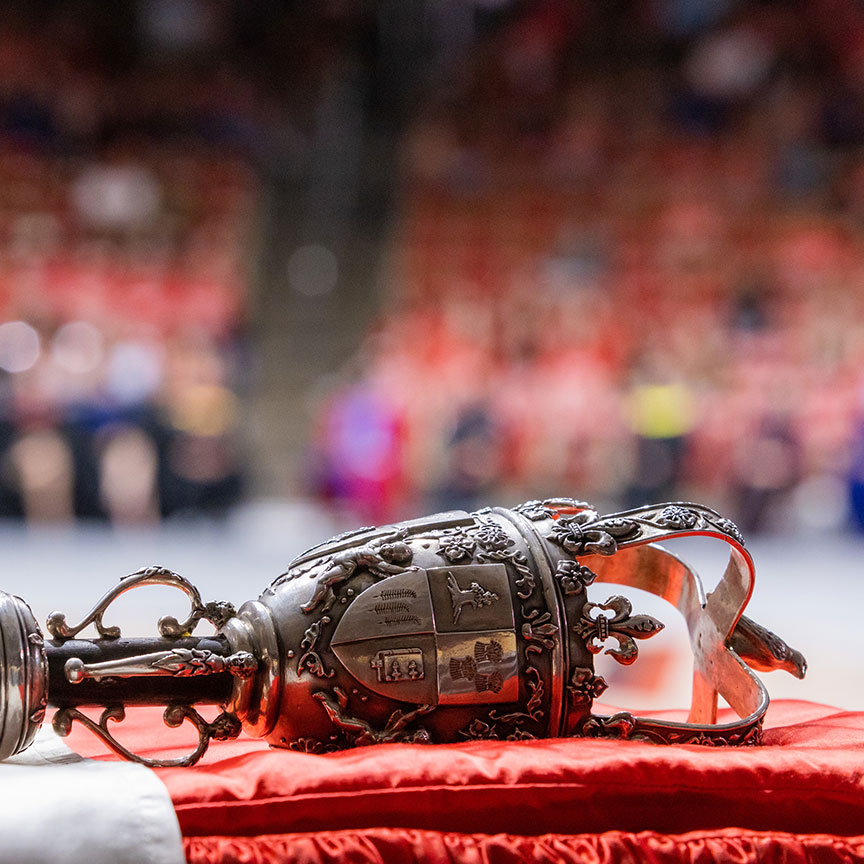
The mace is the most distinguished and unique symbol on a college campus. Its very presence denotes the majesty of academic learning and the importance of intellectual inquiry. “According to a 2000 commencement media advisory from Boston University, ‘Earliest ceremonial maces were borne by the sergeants at arms, royal bodyguards, in England around the time of Richard I,'" about 1200 CE (Harris, 2005, p. 61). Maces were used in the Roman Empire, the Roman Catholic Church, and as a symbol of royal authority. They are also used in the United Kingdom’s House of Commons, the U.S. House of Representatives, and on college campuses across the nation.
An academic mace symbolizes the authority invested in the president by a school’s governing body. When authority is present, the mace is present. This is why the mace is an integral part of the commencement exercises, when students are invested of degrees by the lawful authority of the university, and why the mace plays an important ceremonial role at presidential inaugurations (Harris, 2005, p. 62).
The mace of Southern Utah University was sculpted by Carol Ann Lind, granddaughter of J. Howard Maughan, president of the University from 1922-29, then-known as Branch Agricultural College. Used as an instrument of pomp in the commencement ceremony, the mace signifies order and authority in the academic procession, and is carried at an angle of 45-degrees across the chest.
Seal
In western culture, seals date back to Roman times. The Chinese have used seals as vestiges of authority for at least 3000 years. In the academic tradition, seals have been used in universities since the Middle Ages. Representative of authority and authenticity, the seal plays an important role in the inauguration of a new president. According to Harris, “Because of its symbolic and real significance, the seal is often incorporated into academic ceremonies, especially inaugurations, by being carried in procession in a special container. During the ceremony, as part of the transfer of authority, the seal is handed to the new president along with other symbols of office” (2005, p. 65).