

The Library Garden of Symbols
The Garden of Symbols is a unique fountain with water seeping from two sandstone spires. It is surrounded by symbols of communication including ancient and modern alphabets. You can find the Garden of Symbols in the Sherratt Library by visiting the Garden Level, which is underneath the Main Level.
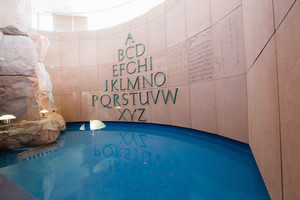
This work was funded through the 1% for Art Program of the Utah Arts Council. The artist, selected in a national competition, was David Philips of Somerville, Massachusetts. The monoliths are local sandstone from Cedar Canyon. The sandstone panels are from a quarry at Torrey, Utah.
Panels
This hieroglyphic writing is from the Egyptian Book of the Dead, a collection of spells that the ancients hoped would enable them to reach a pleasant abode in the next world. Texts of the Book of the Dead are typically found on rolls of papyrus or leather, generally arranged in vertical columns and most often written in simplified linear hieroglyphs or a "short-hand" hieratic script. These scrolls are found buried with a corps either beside it in the coffin, or actually inside mummy wrappings. Over 200 spells are now known; although no single scroll contains all of them. Some spells give the deceased power to revisit the earth, join the gods, or travel in the sky. Other spells are more personal, for example, some restored memory and others secured help in opening the mouth of the deceased to enable them to eat and breathe. To judge from the spells in the Book of the Dead, the ancient Egyptian believed in a life after death. If one were judged worthy, life would be patterned after life on earth with a possible return to earth.
The Chinese characters on this panel are a type commonly found on bronze vessels used anciently in the Far East. The type of writing pictured here is over 3,000 years old and is not readable today.
These Native American petroglyphs from Parowan Gap are among the finest in Utah. There are actually two groups of petroglyphs on the north side of the Gap, one near the east end and the largest one near the west end. While many of the drawings are at ground level, some extend quite high on the boulders and cliffs. All the figures are petroglyphs meaning they are pecked or incised into the rock and not painted. Most of the figures are geometric or abstract although there are some that have a familiar human shape. These human-like figures are known as anthropomorphs and are generally believed to be the work of Fremont Indians. There are hundreds of figures at this important archeological site. The Parowan Gap is easily reached by road just off of Utah Highway 130 between Enoch and Minersville.
This panel shows the ancient Greek alphabet, which was based on the Semitic. The Greeks introduced two important concepts with this script: addition of vowels to the alphabet and the convention of writing left to right. The earliest examples of this writing are found on pottery and clay. Of the three materials for permanent written records, the Greeks used papyrus and vellum (skin). Papyrus was the common medium for writing of books among the Greeks. It was made from a reedy plant grown in the delta region of the Nile. Papyrus text scrolls could be 150 feet in length. Vellum, which was also used, has many advantages over papyrus. Vellum is extremely durable, permits the codex, for book form, and makes possible erasure and rewriting. The Greeks also developed a means of saving and conveying writing in a less permanent form using waxed tablets. These tablets consisted of a smooth wooden surface about four by seven inches covered with black wax, bordered by a raised frame. The malleable wax allowed letters to be inscribed and then erased like a portable chalkboard. The sharp writing instruments used to mark the smooth surface was made of bone, bronze or ivory. The early script was in capital letters with few signs of punctuation and generally documents were not divided into paragraphs. Script on this panel is from a vellum codex.
Ancient writing on Easter Island, in the Pacific Ocean, was done on small wooden tablets made of driftwood or toromiro wood, which is indigenous to the island. The native traditions in regard to these small tablets assert that Hotu-Matua, the first king, introduced this script to his people. He came to Easter Island across the ocean from a distant land and brought with him the knowledge of this written language as well as sixty-seven tablets written in this script containing traditions, genealogical history and proverbs relating to the land from which he came. These tablets are cyriologic in which the words are represented by an actual picture rather than symbolic characters. The pictorial symbols are engraved in regular lines on depressed channels. There are about 500 different symbols on these tablets. In some cases the characters are small and the tablets contain a greater number of lines. In all cases the hieroglyphics are incised and cover both sides as well as the beveled edges of the board on which they are engraved. The symbols on each line are alternately reversed; those on the first stand upright, and those on the next line are upside down and so on in a regular pattern. The reader must turn the tablet at the end of every line. The language on the tablets is still undeciphered.
The Dead Sea Scrolls are ancient texts that have been found in caves in the Judean wilderness west of the Dead Sea. The most famous are the remains of approximately 800 Hebrew, Aramaic and Greek manuscripts that were found in 11 caves near the site call Qumran, several miles south of Jericho. It is believed that these scrolls formed the library of a Jewish community that lived in the area between 150 B.C. and 70 A.D. These scrolls include the oldest copies of nearly all books of the Hebrew Scriptures. The first cave to be discovered in modern times was found by a Bedouin shepherd in 1947. Dating of the scrolls using carbon 14 and accelerator mass spectrometry estimates the older scrolls as having been written about 335 B.C. For some thirty years after the initial discoveries there was much debate and controversy over who should translate, publish and have access to the scrolls. It was not until 1993 that a complete general catalog of the Dead Sea Scrolls was published and the original texts and translations were readily available to the public.
Arabic writing from the Koran, the sacred book of the Muslims is on this panel. The Koran is a compilation of revelations delivered to the prophet Mohammad by the angel Gabriel. The book contains the prophetic utterances delivered over a period of twenty years. All of the utterances are relatively short. Each is made in a different context and was related to the changing circumstances of Mohammad's life. The sayings of Mohammad were collected and written down after Mohammad's death with no concern for chronological order. Parts of the same revelation may be widely separated in the pages of the book. Safeguarding the text of the Koran was the chief impetus to perfect the imprecise system of writing Arabic. As the very words of God, the Koran is the foremost authority for Muslims in all matter of faith and practice. They pay enormous reverence and preserve the contents exactly as they were received from the Prophet. The Koran is approximately the size of the New Testament. It is divided into 114 chapters, each called a surah. Each is further divided into short verses.
The brands represented in this panel were once or are currently being used on cattle, sheep and horses in southern Utah. Branding as a mark of ownership is an ancient practice even depicted in paintings on 4000-year old Egyptian tombs. The conquistador, Fernando Cortez used the shape of a cross to mark the small herd of cattle he brought with him to the New World. Mexican vaqueros passed the custom on to the earliest American cowboys who developed and refined the practice.
The Garden of Symbols also includes brands used by local herders and ranchers to distinguish their livestock.


This panel depicts one verse from the Gutenberg Bible published in 1455. This Bible edition is named for its printer Johann Gutenberg (139? - 1468) and is the first substantial piece of printing to issue from a European printing press featuring movable type. Gutenberg had early training as a goldsmith before he entered the printing trade in the 1430's. He later moved to Mainz and in 1448 he successfully demonstrated that printing from movable type was possible. With the financial backing of Johann Fust, a rich lawyer, Gutenberg printed his famous "42-line" bible (42 lines per column). Printing with movable type became one of the most important landmarks in the development of Western civilization. There are only 47 surviving copies of the Gutenberg bible, of which 12 were printed on vellum. Thirteen copies are in the United States and the copy owned by the Library of Congress is on display in Washington D.C. The text on panel 9 is John 1:1 "In the beginning was the Word, and the Word was with God, and the Word was God."
This panel illustrates both the language of Japanese poets and the beauty of modern Japanese calligraphy. Japanese poets have developed a written language based on Japanese characters to create poetry that is not only beautiful to hear but beautiful to see as well.
The poem on this panel reads:
A duck walking among the reedsgets frost in its feathers.
The cold evening reminds me of my old country side.
John D. Day and Rockin'd Ranch

Registered in 1969, the "Rockin'd Ranch" brand graces the left hip and left thigh of cattle and horses owned by John D. Day. The cattle bred and raised by Mr. Day have been both registered Texas Longhorn and commercial cattle. His registered American Quarter Horses have won state, regional, national and world championships. Rockin'd Ranch livestock have been used in the television and movie industry, where Mr. Day has participated as a wrangler, stunt man and actor. As the first United States Wilderness Ranger in the Pine Valley Mountain Wilderness he also uses his horses in a law enforcement capacity.
Harl E. Judd

G. Elmer Judd registered the "JUD" Judd brand in 1940. Since 1950 the brand has been registered to his son Harl E. Judd. The family owned Hereford cattle were grazed in Cottonwood Canyon west of Kanab, in the Lost Spring Gap Allotment southeast of Kanab and in Arizona at Wahweap allotment by Glen Canyon near the present location of Lake Powell.
Behunin Family

The Behunin Family brand is placed here in memory of Franklin Behunin (1966 to 1993), born a cowboy and who loved the ranching lifestyle. The "Backwards F-B" brand was originally registered to Frank's namesake, his grandfather, who used the brand on cattle and horses. At the age of 16, Frank worked on the Arizona Strip as an entertainer and wrangler and later worked as a professional guide who broke and trained horses. After a work-related snowmobile accident left him paralyzed, Frank had a special saddle made so he could still ride horses.
Warren and Bruce N. Bulloch

Dating back to the early 1900's, the Bulloch brand was placed on the center back of sheep and the left hip on horses and cattle. This brand is known as the "Frying Pan" brand for its close resemblance to that utensil. Brands were chosen for the simple lines, so the brand would come out clear and the owners could identify their animals at a distance. Warren H. Bulloch, son of David Dunn Bulloch, used the brand in his livestock business until approximately 1940. The Bullochs ran approximately 4,000 sheep at the peak of the family livestock business. The brand has remained in the family and is still registered to the family.
D.L. Sargent Family

David LeRoy Sargent began his career at Southern Utah University in 1920 as the Head of the Agricultural Department. In 1924 in order to provide supplemental income for his growing family, Mr. Sargent purchased a 100-acre farm north of Cedar City. It became the first retail dairy business in Cedar City. Widely known as the D. L. Sargent Dairy, the "DL" brand was placed on the left side of the animal and used on dairy cows, sheep, horses and cattle. The "DL" brand was actively used until the death of Mr. Sargent in 1968.
McRae N. Bulloch

The "Spear Head" sheep and cattle brand used by the McRae N. Bulloch family originated over 100 years ago with McRae's father, David C. (Cattle) Bulloch. Hundreds of cattle were branded and grazed family land owned by David C.'s father, David Dunn Bulloch, located at Pipe Springs, Arizona. The Spear Head brand was used by David C. to distinguish his cattle from those owned by his father. The brand was registered in Utah, Arizona and Nevada and is currently being used by the family for livestock. The Bulloch family is proud of their heritage and lengthy affiliation with the livestock business.
Francis H. Middleton Family

John Middleton moved to Iron County in 1856 as a 16-year old English boy and shortly after, relocated at Hamilton Fort where he was one of the first settlers to that area. John became a successful rancher, and was greatly admired by his grandson, Francis Holland Middleton. Francis adopted a variation of his grandfather's cattle brand and placed on the left shoulder of his cattle. The "Bar 7 Bar" was used by Francis from the early 1920's and is still being used today by his sons and grandsons.
Schmutz Family

The Schmutz family cattle brand has been in continuous use since 1889. Used on the left hip, the brand was designed by Gottlieb Schmutz. In 1939 Gottlieb transferred the brand to his son, Eldon Lyman Schmutz who transferred it to his son Eldon William Schmutz in 1977. The brand is currently registered to the Schmutz family corporation where it is used on Hereford range cows. The cattle range an area from Iron Springs in Iron County to Pintura in Washington County.
Alma Evans Family

The Alma Evans Family brand originated with Alma's father, John Arthur Evans, nearly 100 years ago. The first line in the "A" curves upwards to signify the "J" for John while the "A" depicts Arthur and the "E" stands for Evans. The sheep operation ran in the western deserts and Lost Springs area for grazing, and the Chipman Peaks country in the Minersville hills, where the lambing corrals were located. In the 1920's the operation included some 5,000 sheep. Alma and his brother Arthur were in the livestock trucking business for a number of years and ran up to 1,600 cattle at the peak of their partnership in the late 1980's. The brand is currently used by Alma Evans and his sons in their cattle operation.
National Mustang Association

The National Mustang Association (NMA) was founded in 1970 to preserve and protect wild and free roaming horses. A sanctuary was established to provide a home for unadoptable horses removed from public lands. In 1966 over 70 head of horses were grazing on the NAM ranch and allotment. The "NMA" brand is necessary to identify those horses under its protection.
McKeon Land and Cattle

Fascinated by the lore of the Old West and the infamous 1881 gun battle at the OK Corral in Tombstone, Arizona, P.B. McKeon adopted the "OK" brand for his livestock. Originally from Pennsylvania, P.B. married Mary A. Smithson and was one of the first settlers to the Milford Valley. The brand was used on horses during 1902 and 1903 when the family drove 1,500 horses in two herds from Milford, Utah to Los Angeles, California. The third generation to use the brand was P.B.'s grandson, Jack B. McKeon. Fourth and Fifth generation McKeon family members still used the brand today for 2,500 family-owned cattle on feed in southern Utah.
Steve and Cyndi Gilbert

The "Diamond G" brand came into existence in 1989 after Steve and Cyndi Gilbert purchased the famous bull, Ricky, at the National Finals Rodeo Bucking Horse and Bull Sale. The Gilberts have created the "Diamond G" Ranch where Ricky remains the primary stud bull for rodeo breeding purposes. He is a cross between the Charolais and Brahma breeds. The brand is used on all the livestock of the "Diamond G" Rodeo companies that are part of the Professional Rodeo Cowboys Association.
Tom Williams

This brand was originally used by John Lundell before he left the sheep business. Lundell was one of three Swedes who came to southern Utah around the turn of the century to find work and ended up sheep ranching. The Williams family traces its Utah roots to 1878 when Evan E. Williams came from Wales at the age of nine. Around 1920 Evan went into the sheep business and adopted the brand. He was a member of the Mercantile Cooperative until its dissolution in the 1920s. His son, Alex, bought him out in 1941 and started using the "Open Box" brand. Alex's son Tom now uses the brand on his herd of 2,800 sheep.
Philip and Emily H. Foremaster

Philip and Emily H. Foremaster have grazed cattle on the Arizona Strip for over 55 years. The family inherited their love of ranching and the great outdoors from Philip's parents, Ephraim and Ida L. Foremaster. Ephraim and his sons Joe, Philip, Lindau, and Tone have had a successful family owned livestock business on the Strip spanning over 100 years. Placed on the left hip, the "Slash Lazy E" brand used by Philip is a variation of his father's brand, which was a "Block E." Philip, with the help of his children, continued to work with his cattle until the age of 90. The "Slash Lazy E" brand is now owned by his son and daughter-in-law, Howard and Annette Foremaster.
T.W. Jones and Sons

Born in Cedar City a son of early settler Lehi W. Jones, Thomas Willard Jones received an engineering degree from the University of Utah and was one of the owners of the New Castle Reclamation Company. Willard and his wife, Sophia Forsyth Jones, made their home in the western Iron County where Willard was one of the original agricultural developers of the area. Willard operated the family cattle business with his two sons Richard and Uriah. The "Wrench" brand was chosen in 1917 for the ease in forming and applying the brand due to its straight lines and less complicated form. The design is still in used today by Richard Jones, his sons Mason and Steven and their sons Mark, Chris, Eric, and David.
Southern Utah University

In 1913 the Branch Normal School changed names to the Branch Agricultural College. A condition of this change was that the necessary facilities to make the school an agricultural college must be provided by Cedar City. These provisions included supplying livestock and eighty acres of experimental farm land. Over the years many of the livestock animals owned by the university have been donated by Utah ranchers. Subsequently, bulls raised and sold by the university have strengthened the blood line of local herds by upgrading the breeding stock. Since the cattle brand has always represented the initials of the name of the school it has changed as the school has changed. Currently, the brand "SU" is used on the right hip of Hereford, Gelbvieh, black Gelbvieh, and crossbred cattle.
Renn and Marie Zaphiropoulos

Designed by Renn Zaphiropoulos, the "Diamond Z Ranch" brand has been used since 1987. The ranch raises Quarter horses, English Shire draft horses, and Shire / Thoroughbred crosses known as Warmbloods. The Quarter horses are used for pleasure and the sport of barrel racing. "Gentle Giants," as the English Shire is known, are the largest horses in the world. They are prized for their disposition, size, and agility. The Warmbloods are used in driving, dressage, Three Day Eventing, and are excellent all around pleasure horses. The brands are placed on the left hip by "freeze branding." The Zaphiropolouses are proud to be part of the ranching tradition in Iron County.
Randy Lee

This brand is in memory of Randy Lee who felt at one with the earth when he saddled his horse and rode with the wind. Randy and his dad created their brand for the horses, which is the "Backwards R L" brand. The Lee boys always enjoyed working cattle with a good horse and many of the horses they broke and trained are a tribute to this fine young man.
Paul Rowland and Oliver Graham Graff

This brand is known as the "Lone Pine Brand." One-half mile north of Graff Point in Iron County stands the lone pine tree. The lone pine tree can be seen from the valley because the tree is located on the sky line on a ledge near the entrance to Graff Coal Mine. This symbol for the brand and is used on both sheep and cattle.
Richard and June Sewing

Richard and June Sewing moved to New Castle, Utah in 1975 from southern California and currently operate a small hay farm there. In celebration of their venture into rural life they decided to establish a brand to mark their livestock. Although most of the livestock are now gone, the brand still remains a symbol of the choice they made for a new life in southern Utah. The "JR" brand stands for the combined first initials of their names.
Warren Williams

The cattle brand of an upside down "T" used by Warren Williams once belonged to George Perry. The livestock business is usually run by family members, but Perry's were childless so Warren and his brother Tom helped Mr. Perry with fencing and calf branding. When Mr. Perry made the decision to quit the cattle business Warren took over the brand. Warren entered the family sheep business in 1950 with his father Alex. In 1955, to better utilize all of the property the family owned, the branched out into the cattle business for the rougher country was more suited to sheep and the open country better for running cattle. The Williams family runs their cattle in Iron and Washington Counties in Utah, and Lincoln County in Nevada.
Charles Gustave Lundgren Family

Charles Gustave Lundgren came into this country from Sweden in 1888. Shortly after his arrival he moved to Kanab, Utah and began herding sheep. He took his wages half in sheep and half in money, which was the beginning of his herd of Ramboullet sheep. Two solid dots were used as a brand because it was easy to find a forked branch or a tin can for the paint brand. Additionally, the brand was easy to identify at a distance. The dots were placed on the back so they could be seen from either side when working the herd. The Lundgren LLC Ranch is currently based in Iron County and owned by second, third, and fourth generation family members. Today the herd contains both Rambouillet and Suffolk sheep.
Craig Jones Family

Thomas Jones used the "TJ" brand in the mid to late 1800s. It was later passed down in the family to Lehi Jones and his sons who ran a cooperative livestock organization. One year the tail of the "J" broke off thus turning the branding iron into a "TI." Since the family only owned one branding iron they kept using that brand and later filed for a change in brands with the Utah Department of Agriculture. For most of the 20th century the family used the "TI" brand for cattle and sheep. The brand was place on different sections of cattle (such as the ribs, left hip, and so on) to designate ownership within the large family. The brand was always placed on the back of sheep, but different colors were used to distinguish different owners. It is still being used today, though the active ranching descendants of Lehi Jones are far fewer, as are the numbers of cattle and sheep using the brand.
Don Dee and Mary Alice Gates

Don Dee and Mary Alice Gates have run cattle on the Arizona Strip and in Utah for many years. Their interest in the livestock business began on the Philip Foremaster ranch on the Strip where the family gathered to work hard and enjoy the raw beauty of the land. A love of horses, cattle and the wide open spaces was developed by the Foremaster children and grandchildren. When the time came for Philip Foremaster to sell his ranch, his son-in-law and daughter Don and Mary Alice F. Gates and son and daughter-in-law Howard and Annette Foremaster bought the family ranch. The "J Heart" brand is used by Don Dee and Mary Alice Gates and is placed on the left shoulder of their cattle and horses. The ranch is currently run by second and third generation offspring of Philip Foremaster.
Waldon Isom

Born January 18,1905 in Hurricane, Utah, Waldon Isom was raised by older siblings after the deaths of both is father and mother. Waldon started helping with the cattle at age six and was essentially out on his own at age twelve. He often joked that he wasn't raised, he was "jerked up!" The family ranch was located at Iron Springs, but they also ran their cattle on mountain property east of Cedar City. Waldon upgraded his cattle each year until he had top quality Herefords. After a series of heart attacks in 1987 he was forced to five up the ranching he loved all his life, but the spirit of this self-made man remained out on the range. Waldon is now deceased and his son, W. Elwin Isom, currently uses the brand on his ranch in Fruitland, Idaho. The "FI" brand stood for the initials of Waldon's father Franklin Isom.
Theodor Rimpau

The "TU" brand is proudly used by the Rimpau family who has been in the livestock business for eleven generations. The original brand was quite ornate with curlicues on either side of the "T" (representing Theodor) and the "U" ( the last letter of Rimpau). The brand was later simplified to its current form so it could be recognized at a distance on an animal and not mistaken for someone else's brand. It was approximately the size of a 3-pound coffee can lid and first used in Orange County, California. More recently it was used by Theodore Rimpau in Milford, Utah on the center back of Hampshire sheep.
Mel Murie

The Murie family has been involved in the livestock business in this area since the first settlers arrived here. Mel Murie loved the ranching lifestyle and enjoyed spending all of his time with his cattle, whether on the mountain in the summer or in the desert in the winter. Mel's original cattle brand was "7K." In 1956 he purchased a desert ranch and the brand "71 Bar" came with it. It was used on the left hip and was clear and easy to read. Mel passed away in 1982 but the ranch continues to be a family cattle operation.
Leigh Livestock Company and Richard and Fern Leigh

The "Backwards DL" brand was registered by Richard Leigh's grandfather, Herny Leigh over 100 years ago and was used on both cattle and sheep. Richard's father, Webster Leigh, used this brand during his lifetime. Richard has kept the brand and it is currently being used on over 400 cattle. Richard Leigh expects his children to continue to operate Leigh Livestock Company and to use this brand on the left hip of the cattle.
Than Naegle

"JN" was the brand of John Conrad Naegle, pioneer, farmer, rancher, and colonizer. He made his way west at the age of 19 with the Mormon exodus from Nauvoo to Winter Quarters. His first ranching endeavor was near Lehi, Utah where his ranch included the present Saratoga Springs on the shore of Utah Lake. Called by Brigham Young to establish the wind industry in Utah's Dixie, Naegle expanded his ranch operation in Beaver and Kaibab Forest on the North Rim of the Grand Canyon. A polygamist with seven wives, Toquerville became his headquarters for 24 years. Pressure from U.S. Marshals caused him to relocated part of his family to St. Johns, Arizona and finally into the Mormon Colonies of Old Mexico where he died in 1899. Thousands of horses and cattle were branded with the "JN" brand in the early day of Utah, Arizona, and Mexico.
Rulan and Lois Woodbury

The "Lazy JU" brand originally belonged to D. Claude and Martha P. Urie, Cedar City, Utah. The Uries homesteaded some desert property west of Cedar City in approximately 1920 and were excited to see their dream fulfilled when they put cattle on the range. In later years their son Howard took over the operation. When both Claude and Howard died, their son-in-law and daughter Rulan and Lois Urie Woodbury helped Martha run the operation and kept the brand in the Urie family. The brand is still registered to the Woodburys and used on Black Angus and Herefords.