

SUU Students Experience the Rhythm of Rio
Published: July 27, 2026 | Author: Kol Gibson | Read Time: 6 minutes
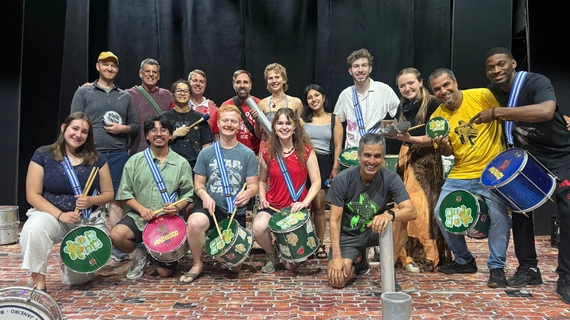 For two weeks this summer, a group of Southern Utah University percussion students traded Cedar City for Rio de Janeiro, immersing themselves in one of the world’s most vibrant musical cultures. Alongside students and faculty from Utah Valley University, they studied with percussionists at the Federal University of the State of Rio de Janeiro (UNIRIO), performing, attending concerts, and experiencing firsthand the traditions that have shaped percussion around the world.
For Dr. Jed Blodgett, Director of Percussion Studies at SUU, the trip was much more than an international tour. It was an opportunity for students to experience music in the place where so many influential styles were born. “Rio de Janeiro is known for its incredible music scene,” Blodgett said. “Any night of the week, we could find live music on just about any street corner. It’s the birthplace of samba, bossa nova, choro, and pagode, and many of the percussion instruments we use in the United States originated there.”
The collaboration began through Blodgett’s longtime friendship with Dr. Shane Jones, Director of Percussion at UVU. After the trip was planned, Blodgett reached out to UNIRIO faculty members Dr. Ana Letícia Barros and Paraguassú Abrahão, who enthusiastically embraced the idea of an international exchange. Their excitement grew into the creation of the Série Internacional de Percussão da UNIRIO (UNIRIO International Percussion Series), bringing together students, faculty, and guest artists from around the world.
Throughout the trip, students participated in masterclasses, rehearsals, clinics, and performances while also attending live concerts across the city. Faculty members from SUU, including Commercial Music professor Dr. McKay Tebbs, and UVU presented clinics for UNIRIO students and the public, creating an exchange where everyone involved had the opportunity to teach and learn.
The highlight of the experience came during a collaborative concert in UNIRIO’s Villa-Lobos Concert Hall, where students from all three universities performed together after spending the week rehearsing side by side. “The first week was primarily spent in classes and rehearsals with UNIRIO students, and it culminated in a combined concert,” explained Blodgett. “The concert was a powerful moment for both the audience and the performers.”
While music brought everyone together, the relationships formed outside the rehearsal room proved just as meaningful. “Despite the language barrier, we built lasting relationships with students and faculty at UNIRIO,” Blodgett said. “Even after the exchange ended, they continued spending time with us at the beach, at concerts, and during other activities.”
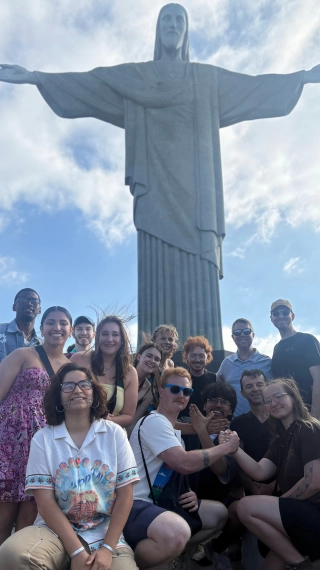 For senior Music Education major Cambria Slaugh, those connections demonstrated that music can communicate across cultures in ways words sometimes cannot. “The most impactful thing to me was rehearsing and performing a concert with the UNIRIO students,” Slaugh said. “Even though we didn’t speak each other’s languages, we all spoke the language of music and percussion, and we were able to collaborate and make beautiful and fun music despite our different life experiences.”
The experience also transformed how students think about music itself. One evening, Slaugh watched the group Choro Batucada perform in a crowded Rio venue. The musicians sat around a long table with their instruments scattered between them, improvising effortlessly while feeding off each other’s energy. “It was the most lively performance I’ve ever seen,” she said. “It inspired me to make music with friends and community more often rather than focusing on solo performances.”
That emphasis on community challenged some of the assumptions Slaugh had developed through years of classical training. “Seeing samba school music and choro changed my perception of what it means to be a musician,” she said. “In these traditions, it is more about making music as a community. Every instrument plays an important role, not necessarily in a virtuosic way, but each part is vital to the group’s sound.”
Students also discovered that becoming a better musician sometimes means becoming a beginner again. As a percussionist, Slaugh is accustomed to learning many different instruments, but Brazil introduced her to instruments and techniques she had never encountered before. “It was humbling,” she said. “I had experiences where I was playing instruments that were completely new to me. Instead of feeling discouraged, it reminded me that there’s always more to learn.”
For Dr. Blodgett, those moments of growth extended well beyond musical technique. “Two weeks is a very short time to develop technical skills,” he said. “But their awareness and appreciation for another musical culture grew dramatically. It was evident in the way they talked about music and Brazilian culture throughout the trip.”
He believes that kind of understanding simply can’t be recreated in the classroom. “Context is everything,” Blodgett said. “Too much of what we bring into academia loses its significance when it’s taken out of context. Slavery, race, language, politics, education, weather, and even food all influence the real meaning of many styles of Brazilian music.”
The cultural immersion left an equally lasting impression on Slaugh. Navigating a country where she didn’t speak the language helped her develop a deeper sense of empathy. “It made me want to lead with more compassion when I meet people in the US who come from another country or can’t speak English,” she said. “I was only in Brazil for 12 days. I can’t imagine how difficult it would be to build a life somewhere without knowing the language.”
Experiences like this are a natural extension of the department’s educational philosophy. “Trips like this provide a truly dynamic educational environment and build a community of learners,” Blodgett said. “A community that crosses international borders.”
The Brazil exchange reflects the kinds of opportunities available to students studying percussion at SUU, where performance, collaboration, and global experiences are all part of the educational journey. “Students should expect to have unique musical and cultural experiences on a regular basis,” Blodgett said. “They should also expect to see unique programming and curriculum within our ensembles and classes.”
For Slaugh, the trip confirmed she had chosen the right place to study. “It has been the most impactful part of my college experience,” she said. “Dr. Blodgett and Joe Howe have been incredible influences on me as a performer and as a human. Through percussion, I’ve made some of my best friends and had life-changing musical and non-musical experiences.”
As the group returned home, they brought back more than new rhythms and techniques. They returned with international friendships, a broader understanding of music’s role in culture, and a reminder that some of the most meaningful education happens far beyond the walls of a classroom.
To learn more about Percussion at SUU, visit www.suu.edu/pva/music/percussion/.
About the College of Performing and Visual Arts
The College of Performing and Visual Arts (CPVA) at Southern Utah University comprises 41 academic programs, including liberal arts (BA/BS) and professional (BFA, BM, BMEd) degrees in art, design, dance, filmmaking, music, and theatre. It includes graduate programs in the fields of arts administration (MFA, MA), music education (MME), and music technology (MM). More than 60 full-time faculty and staff are engaged in teaching and mentoring over 900 majors in the College. CPVA presents over 100 performances, lectures, presentations, and exhibitions each year, which are complemented by the Southern Utah Museum of Art (SUMA) and Shakespeare Studies at SUU, and is affiliated with the Tony award-winning Utah Shakespeare Festival (USF). Southern Utah University is an accredited member of the National Association of Schools of Art & Design (NASAD), National Association of Schools of Dance (NASD), National Association of Schools of Music (NASM), and the National Association of Schools of Theatre (NAST), making SUU the first public university in the state of Utah to be accredited by all four associations. For more information about the College of Performing and Visual Arts, visit www.suu.edu/pva.Contact Information
Kol Gibson
435-865-8667
kolgibson@suu.edu