

General Education
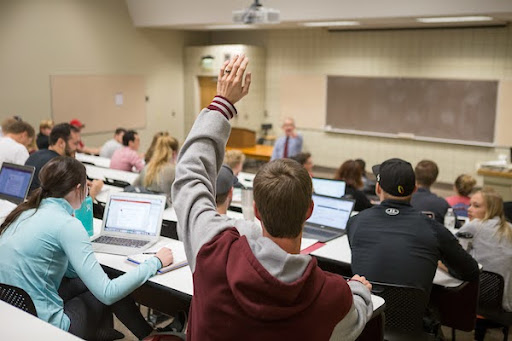 The General Education (GE) program at Southern Utah University (SUU) is meticulously crafted to shape well-rounded graduates. Rooted in SUU's mission to foster engaged, personalized, and rigorous learning, the GE curriculum offers broad subject-area knowledge and essential learning skills that serve as the foundation for students' academic pursuits and beyond.
At SUU, our general education curriculum is carefully designed to support students throughout their educational journey and prepare them for the challenges they'll encounter beyond the university setting. Each content area is structured to foster exploration, impart valuable knowledge, and nurture skills that are not only relevant during their time at SUU but also beneficial throughout their careers and lives. By embracing SUU's motto, "Learning Lives Forever," our GE courses empower students to continue their pursuit of knowledge long after they graduate.
Core Requirements & Learning Outcomes
The core requirements for General Education encompass 12 credit hours of coursework in Written Communication, Quantitative Literacy, and American Institutions. These courses are intended to give students the knowledge and skills necessary to effectively communicate, be able to demonstrate basic mathematical competency, and have an understanding of the history of the United States and its economic and political systems.
Upon successful completion of the Written Communication requirement, students will be able to:
- Locate, evaluate, and integrate credible and relevant sources to achieve various writing purposes;
- Demonstrate critical and conceptual awareness of genre in reading and writing-including organization, content, presentation, formatting, and stylistic choices
- Analyze rhetorical situations and adapt to the audience, purpose, modalities, and the circumstances surrounding a range of reading and writing tasks
- Recognize and make intentional, critical, and contextually-informed language choices across a range of rhetorical contexts/situations
- Develop flexible, iterative, and reflective processes for invention, drafting, workshopping, and revision.
Upon successful completion of the Quantitative Literacy requirement, students will be able to:
- Use correct terminology and proper notation to explain quantitative or mathematical relationships (equations, graphs, diagrams, tables, data) and to support an argument, assertion, or purpose using quantitative or mathematical evidence
- Convert quantitative or mathematical information into appropriate mathematical representations and/or models such as equations, graphs, diagrams, or tables, including making and evaluating important assumptions as needed
- Use algebraic skills and techniques to solve problems, including the ability to identify and correct errors in calculations and understanding the role and proper use of technology in assisting with calculations
- Draw appropriate conclusions through quantitative or mathematical analysis of data or models, including understanding and evaluating important assumptions in order to recognize the limits of the analysis
- Solve concrete and abstract problems across multiple disciplines.
Upon successful completion of the General Education American Institutions requirement, students will be able to:
- Analyze, contextualize, and interpret primary and secondary source documents to understand the history, principles, form of government, and economic system of the United States
- Locate, evaluate, and use historically, politically, and economically relevant information and data to develop and enhance information literacy and research skills
- Communicate effectively about the history, principles, form of government, multicultural populations, and economic system of the United States
- Engage diverse viewpoints that contribute to a constructive dialogue about the history, principles, form of government, and economic system of the United States
- Apply historical, political, and economic perspectives and methods as appropriate to address big questions or threshold concepts pertaining to the history, political system, and economic system of the United States.
Breadth Area Requirements & Learning Outcomes
For these requirements 15 credits of introductory coursework are required across five Breadth Areas: Arts, Humanities, Social and Behavioral Sciences, Life Sciences, and Physical Sciences.
Upon successful completion of the General Education Arts requirement, students will be able to:
- Explain the creative artistic process as an iterative and recursive practice culminating in an expression of human experience and emotion through a medium
- Apply artistic concepts and ideas drawn from traditions of artistic creation and theory to better engage with, analyze and understand a creative work
- Examine connections between art and society and articulate how the arts are a historical and cultural phenomenon.
Upon successful completion of the General Education Humanities requirement, students will be able to:
- Examine how humanities artifacts (such as oral narratives, literature, philosophy, media, and artworks) express the human condition
- Explain how humanities artifacts take on meaning within networks or systems (such as languages, cultures, values, and worldviews) that account for the complexities and uncertainties of the human condition
- Analyze humanities artifacts according to humanities methodologies, such as a close analysis, questioning, reasoning, interpretation, and critical thinking
- Compare and contrast diverse humanistic perspectives across cultures, communities, and/or time periods to explain how people make meaning of their lives
- Using humanities perspectives, reflect on big questions related to aesthetics, values, meaning, and ethics and how those apply to their own lives.
Upon successful completion of the General Education Social and Behavioral Sciences requirement, students will be able to:
- Examine institutions and human behavior through social and behavioral concepts, methods, or theories
- Identify diverse perspectives to explore and examine social and behavioral phenomena
- Apply discipline-relevant and scientific theories and methods to make inferences about or applications to social and behavioral phenomena at personal, institutional, or cultural levels.
Upon successful completion of the General Education Life Sciences requirement, students will be able to:
- Describe and apply approaches to scientific discovery and interpretation of experimental data
- Demonstrate understanding of matter, energy, and their influence on biological systems
- Describe and apply evolutionary concepts in terms of inheritance, adaptation, and diversity of life
- Explain the mechanisms of information storage, expression, and exchange in living organisms or eco-systems
- Reflect on the relevance of life sciences in a broader context.
Upon successful completion of the General Education Physical Sciences requirement, students will be able to:
- Explain science as a process and as a way of understanding the physical world
- Demonstrate understanding of matter, energy, and their influence on physical systems
- Evaluate the credibility of various sources of information about science-related issues
- Describe how the Physical Sciences utilize their foundational principles to confront and solve pressing local and global challenges, shaping historical, ethical, or social landscapes in the process.
Optimizing GE: Advisor Tips for Success
General education is a foundation to your experience at SUU. We as advisors would love for you to have the best experience possible with your Gen Eds. Please utilize the following pro tips to maximize your engagement and your time with Gen Eds:
- "I want to knock out my generals, then move onto my major." Although this may sound like the best possible option, in multiple cases it may hinder you. While working with your advisor, you can learn how to maximize the benefits of your general education. We can help you look for courses that not only peak an interest for you, but may also unexpectedly tie together with your intended major.
- Some majors have more required courses and less flexibility. In these cases it can be beneficial to have a course that acts as a buffer to your other courses. Generals can offer an exciting way to explore new hobbies or interests while diversifying your schedule.
- Oftentimes Gen Eds overlap with major requirements. Rather than taking a Gen Ed to simply “get it out of the way”, work with your advisor to find an avenue where you can use Gen Eds to your advantage.
- Gen Eds consist of both core and knowledge area requirements (as you can learn about above). English, Math, and American Institutions comprise the core. These courses are fundamental to your success. Due to this, we strongly encourage completion of the core before 60 credits.
Advisors want students to understand their path at SUU. Please feel free to schedule an appointment with us so that you understand how Gen Eds are utilized in your education!