

The Flowing Line: Psychedelia & the Art Nouveau Revival
January 17 - April 24, 2026
Jimmie F. Jones Gallery
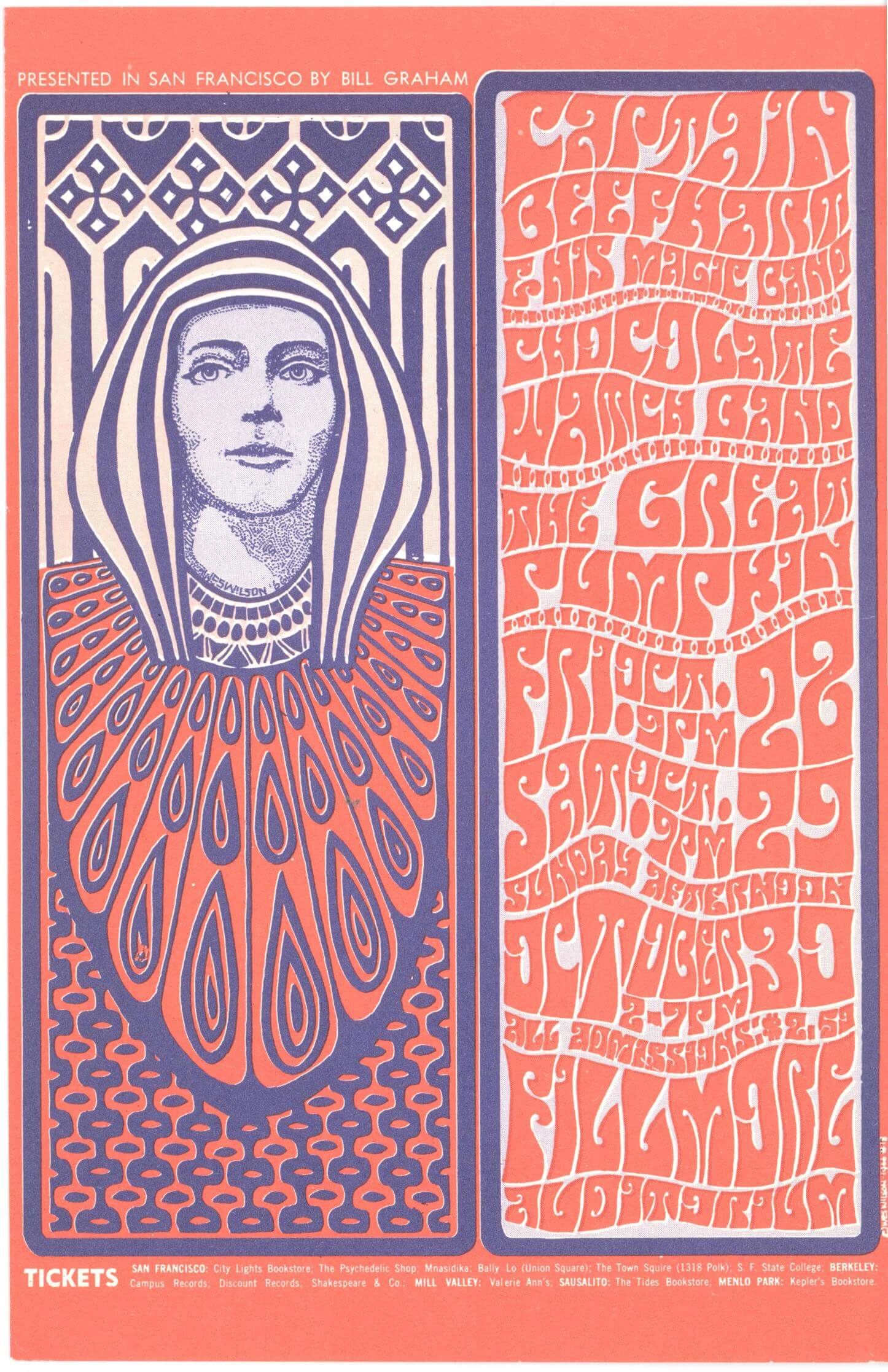 In the late 1960s, the experimental artists hired to design concert posters for Bill Graham’s Fillmore West and other legendary music venues at the center of San Francisco’s counterculture were creating a new visual language to reflect psychedelic experience. Although these artists were generating something entirely novel—in their own individual work and as a collective artistic movement—they were drawing from the past to inspire their contemporary compositions.
Art Nouveau (“New Art”), a style popular in European and American art and architecture from the 1880s through the First World War, found a new audience and renewed popularity in the 1960s art scene. Art Nouveau is defined by sinuous, flowing lines and “whiplash” curves that not only mimic the forms of the natural world, but also serve as a metaphor for artistic freedom.
Seeking their own liberation from traditional stylistic constraints, the counterculture artists of the Bay Area and beyond found kindred spirits in Art Nouveau luminaries, such as Gustav Klimt and Alphonse Mucha—especially their flowing lines, curved fonts, vegetal patterns, ethereal women, and allusions to Asian and Egyptian visual culture.
The work of Wes Wilson, one of the Fillmore’s primary poster designers, exemplifies the Art Nouveau revival of the psychedelic era. Drawn from SUMA’s extensive collection of rock posters and handbills, this exhibition highlights some of Wilson’s most iconic designs that illustrate the flowing line that channeled Art Nouveau aesthetics into psychedelic expression.
Image:
Wes Wilson (American, 1937 - 2020), Bill Graham Presents #34, 1967, Lithograph on paper, 7 x 4.5 in., Southern Utah Museum of Art
Contact
Southern Utah Museum of Art